

A trustworthy beauty review tells you who tested the product, what active ingredients address your specific concern, how it performed under real-world conditions, and whether the reviewer has any financial relationship with the brand. Without those four things, you are essentially reading marketing copy with a star rating attached.
Here is what a solid review should include:
- Reviewer credentials: A named tester with a declared skin type, or an editorial board that includes board-certified dermatologists or licensed makeup artists
- Ingredient transparency: The full INCI list with key actives called out by name and concentration
- Testing protocol: Duration, wear conditions (gym, long workday, outdoors), and environmental context
- Conflict-of-interest disclosure: Clear labeling of sponsored content, gifted samples, or affiliate relationships
- Real-world results: Not just first impressions, but how the product held up over days or weeks
Sources like Byrdie model this well, maintaining an expert review board including board-certified dermatologists. Tools like INCIDecoder let you verify ingredient claims independently. Stacyknows applies the same ingredient-forward lens across its beauty coverage, from trend pieces to curated finds.
| What to check | Why it matters |
|---|---|
| Reviewer skin type declared | Lets you judge if the result applies to you |
| Active ingredients named | Connects the formula to a real clinical benefit |
| Testing duration stated | Short tests miss delayed reactions and wear breakdown |
| Sponsorship disclosed | Reveals potential bias in the verdict |
| Expert vetting noted | Adds scientific accuracy to editorial claims |
Pro Tip: Before you read the verdict, scroll straight to the disclosure section. If there is none, treat the entire review as a brand press release until proven otherwise.
How do you actually read a beauty review?
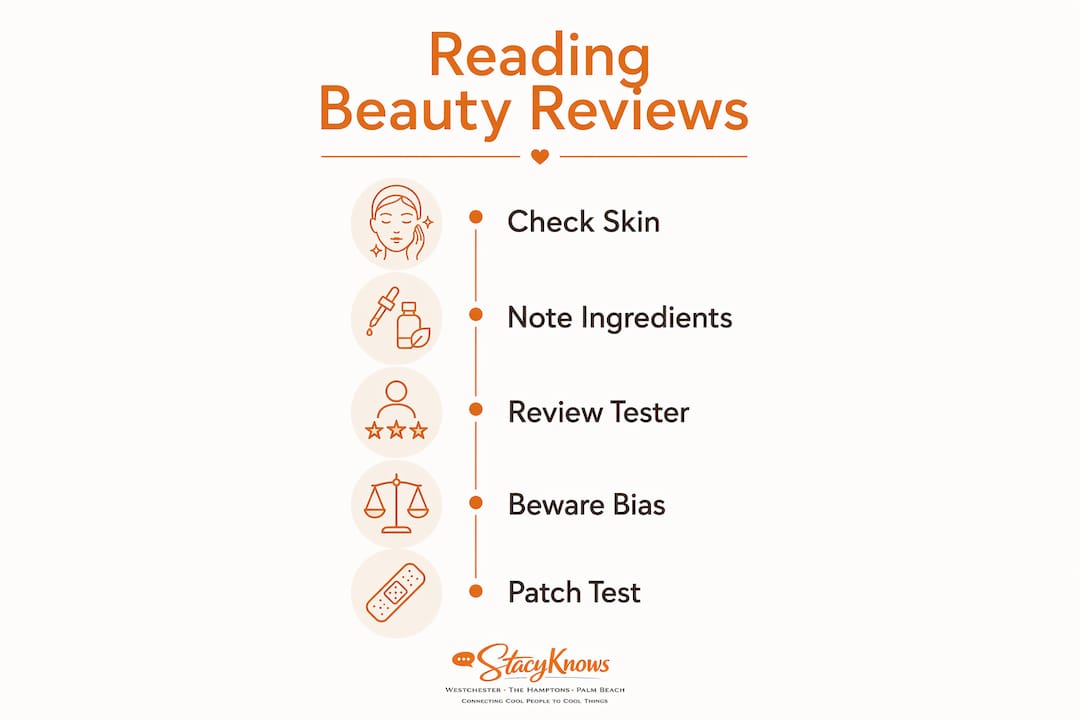
Most readers skim to the verdict and miss the signals that tell them whether the verdict applies to their skin. Here is a checklist you can run through in under a minute.
- Read the headline claim skeptically. “Best moisturizer for dry skin” is an editorial opinion, not a clinical finding. Note it, then keep reading.
- Check reviewer credentials. Is there a named tester with a declared skin type? Does the publication list a dermatologist or licensed makeup artist on its review board?
- Scan the ingredient list. Use INCIDecoder or Think Dirty to decode the INCI and confirm whether the actives match the product’s claims. A moisturizer that leads with fragrance and alcohol is not what the label implies.
- Look for testing depth. How long did they test it? Under what conditions? Reviews that declare skin type and testing conditions make it far easier to judge whether the result translates to your own situation.
- Check for wear-test details. Products can pill, oxidize, or break down under real-world stressors like gym heat or a long workday. A review that only covers first application is incomplete.
- Verify disclosures. Gifted product, affiliate link, or paid partnership? Each one is fine as long as it is labeled. Unlabeled is the red flag.
A rigorous review explains test conditions, declares the reviewer’s skin type, records duration and environment, and includes before-and-after photos taken under consistent lighting. Without those elements, the review is an impression, not an evaluation.
Pro Tip: When a review lists the exact shade, skin tone, and climate the tester was in, that specificity is a trust signal. Vague reviews (“it felt great on my skin!”) tell you almost nothing useful.
Where can you find beauty reviews you can actually trust?
Different sources do different things well. Knowing which to reach for, and why, saves a lot of wasted product money.

| Source | Best for | Expertise level | Ingredient transparency | Format |
|---|---|---|---|---|
| Byrdie | Clinically informed editorial reviews | High (45+ specialist board) | Strong | Deep reviews + roundups |
| INCIDecoder | Parsing INCI lists and ingredient functions | Database-level | Highest | Tool, not editorial |
| SkinSort | Matching products to your skin profile | Community + database | High | Filter-based search |
| EWG Skin Deep | Ingredient safety and toxicity scoring | Scientific database | Highest | Rating tool |
| Think Dirty | Barcode scanning for ingredient risk | App-based | High | Mobile tool |
| Marie Claire | Wear testing, texture, lifestyle fit | Editorial | Moderate | Long-form reviews |
| Who What Wear | Trend-forward editorial, real-world wear | Editorial | Moderate | Personal reviews |
| Stacyknows | Lifestyle-first, ingredient-aware guides | Editorial + expert input | Strong | Curated guides + trend pieces |
A few things worth noting about how to use these together. EWG Skin Deep combines toxicity, regulatory, and study-availability databases to score products, and issues an EWG VERIFIED® mark for those meeting its strictest standards. That makes it a strong cross-check when a review makes safety claims. SkinSort takes a different angle, helping you filter by skin profile rather than chasing a universal “best” pick.
For ingredient-conscious shoppers, the Think Dirty app lets you scan barcodes to get ingredient-level risk information and cleaner alternatives on the spot.
How do you match a product review to your own skin profile?
The single biggest mistake readers make is treating a “best of” list as a personal prescription. What works for a reviewer with oily, acne-prone skin in a humid climate may actively irritate dry, sensitive skin in a dry one.
- Build a quick skin profile. Write down: oil level (oily, dry, combination), sensitivity level, primary concerns (acne, hyperpigmentation, fine lines, redness), and any known allergens or triggers.
- Match actives to your concern. Use INCIDecoder to confirm the product actually contains the active at a meaningful position in the INCI list. Salicylic acid for acne, niacinamide for redness and pores, squalane for barrier support, retinoids for aging concerns.
- Filter reviews by declared skin type. Prefer reviews where the tester explicitly states their skin profile and testing conditions. Personalized reviews tied to a specific skin profile are more useful than generic “best” lists.
- Start with samples or travel sizes. Track results for the timeline appropriate to the active: 3–7 days for a basic moisturizer, 4–12 weeks for retinoids or chemical exfoliants.
When to stop and see a dermatologist: persistent redness, burning that does not resolve within 48 hours, or breakouts that worsen after two weeks of consistent use.
Pro Tip: Knowing your skincare application order matters as much as the products you choose. Layering actives incorrectly can cancel out benefits or cause irritation even with well-reviewed products.
How do you test a new beauty product safely at home?
| Phase | Timeframe | What to watch for |
|---|---|---|
| Patch test | 24–48 hours | Redness, itching, swelling at test site |
| Initial wear | Days 1–7 | Pilling, oxidation, sensitivity, texture changes |
| Short-term results | Weeks 2–4 | Hydration, breakouts, texture improvement |
| Active ingredient results | Weeks 4–12 | Visible changes in pigmentation, lines, or acne |
Patch test instructions: Apply a small amount to the inside of your wrist or behind your ear. Leave it for 24 hours without washing. Any redness, itching, or swelling means stop use and consult a clinician before proceeding.
For wear testing, run the product through at least one gym session, one long workday, and one outdoor outing. Note whether it pills under SPF, oxidizes by midday, or breaks down in heat.
Log your results with these fields: product name and batch number, start date, skin type and current concerns, environmental conditions (humidity, season), any reactions, and weekly photos taken in the same lighting.
Pro Tip: Consistent lighting in your tracking photos matters more than you might think. A bathroom with warm bulbs will make your skin look more even than it is, masking real changes. Natural window light is the most reliable.
What do the ingredient terms in reviews actually mean?
- Salicylic acid: A beta-hydroxy acid that exfoliates inside the pore. Best for oily and acne-prone skin. Typical effective concentrations: 0.5–2%. Can be drying at higher concentrations; avoid if sensitive to aspirin.
- Niacinamide: A form of vitamin B3 that reduces redness, minimizes pore appearance, and supports the skin barrier. Well-tolerated by most skin types, including sensitive. Look for 2–10% in formulas.
- Squalane: A lightweight, stable oil derived from olives or sugarcane that mimics the skin’s own sebum. Suitable for all skin types, including oily. Appears in the Lisa Eldridge Seamless Skin Enhancing Tint alongside glycerin for a reason.
- Retinol / retinoids: Vitamin A derivatives that accelerate cell turnover and stimulate collagen. Expect 4–12 weeks before visible results. Start low (0.025–0.1%) and introduce slowly to avoid irritation.
- Humectants: Ingredients that draw moisture into the skin (glycerin, hyaluronic acid). Work best when applied to damp skin and sealed with an occlusive.
- Occlusives: Ingredients that form a barrier to lock in moisture (petrolatum, shea butter, beeswax). Essential for dry and compromised skin barriers.
- INCI: International Nomenclature of Cosmetic Ingredients. The standardized ingredient list every product must display. Use INCIDecoder to translate it into plain language and flag potential irritants.
Ingredient-checker apps like Think Dirty and EWG Skin Deep help identify potentially harmful ingredients and prioritize products with transparent sourcing. Learning to evaluate skincare ingredients yourself is the fastest way to stop being misled by marketing language.
What are the red flags that a beauty review is not reliable?
Some are obvious. Others are easy to miss.
- No disclosure of sponsorship or gifted product. This is the clearest sign of a compromised review.
- No testing methodology. If the reviewer does not say how long they tested or under what conditions, the verdict is just a first impression.
- Missing INCI list. A review that praises a formula without naming the actives is describing packaging, not performance.
- Single-sample claims presented as universal results. One person’s experience is not a clinical finding.
- Identical phrasing across multiple reviews. Copy-pasted language across different platforms often signals coordinated fake reviews or brand-seeded content.
- No trade-offs mentioned. Every product has limitations. A review with zero cons is almost certainly incomplete or sponsored.
- “Miracle” language. Phrases like “completely transformed my skin in three days” or “erased all my fine lines” are not physically possible in that timeframe for most actives.
If a review reads like the brand wrote it, the brand probably did. Look for named testers, declared skin types, honest trade-offs, and a disclosure section. Those four things separate editorial content from advertorial content.
Cross-check any suspicious review with EWG Skin Deep or INCIDecoder to verify ingredient claims independently. Prefer platforms that name their expert contributors and explain their vetting process.
Why does expert oversight change how much you can trust a review?
A review written by a beauty editor alone carries one kind of value: lived experience with a product. A review audited by a board-certified dermatologist carries something additional: scientific accuracy on ingredient claims, contraindications, and concentration thresholds.
Byrdie’s expert board of over 45 specialists audits content for medical and scientific accuracy. That means when a Byrdie article says niacinamide reduces redness, a dermatologist has confirmed the claim holds up against the evidence. Without that layer, editorial teams can inadvertently repeat marketing claims as fact.
Makeup artist oversight adds a different dimension. A licensed artist can assess whether a foundation actually performs across skin tones, whether a setting spray causes pilling under studio lights, and whether a product’s texture description matches its real-world application. Both types of vetting matter, and they address different questions. Stacyknows brings in expert voices for exactly this reason, as seen in coverage like the TikTok anti-aging myths piece featuring plastic surgeon Dr. Frederick Weniger.
The Stacyknows approach to beauty coverage
Stacyknows covers beauty from a lifestyle-first perspective, which means the question is never just “does this ingredient work?” but “does this product work for someone with your life?” That includes how a product layers under SPF on a busy morning, how it holds up through a workout, and whether the formula suits skin that is navigating hormonal changes, aging, or environmental stress.
The editorial values here are straightforward: ingredient transparency, honest disclosure of any brand relationships, and testing that reflects real daily use rather than controlled lab conditions. When Stacyknows covers a trend like the glycolic acid and Nivea crème combination, the coverage explains the ingredient rationale, not just the viral moment. The Beauty Over 50 guide applies the same logic to age-specific concerns, with expert input shaping the product recommendations.
What readers can expect on every Stacyknows beauty piece: who tested it, how it was tested, which ingredients matter and why, and a clear note on any brand relationship. No mystery, no hidden agendas.
Stacyknows curated beauty finds: a shortcut to the workflow
Reading reviews is one thing. Applying the workflow above to hundreds of products is another. Stacyknows has done a lot of that filtering already.

The Stacyknows Beauty Secret Finds page is a curated collection of editor-vetted picks organized around real concerns and lifestyle scenarios, not just trending launches. If you want ingredient-forward picks with lifestyle context already baked in, that is the fastest starting point. For readers who want to go deeper on age-specific routines, the Beauty Over 50 guide covers actives, textures, and product categories suited to skin that has changed over time. Browse both, apply the checklist from this article, and you will spend less time second-guessing reviews and more time finding products that actually work for you.
Sources and further reading
- Byrdie: Editorial reviews backed by a 45+ specialist board; best for clinically informed product assessments and ingredient-focused roundups.
- INCIDecoder: Paste any INCI list to get plain-language ingredient functions and irritancy flags; use this before buying any new product.
- SkinSort: Filter products by skin profile (fungal acne–safe, fragrance-free, etc.); best for personalized matching rather than generic rankings.
- EWG Skin Deep: Ingredient safety database with toxicity scoring and the EWG VERIFIED® mark; use for safety cross-checks.
- Think Dirty: Barcode-scanning app for on-the-spot ingredient risk information; ideal for in-store shopping.
- Marie Claire: Long-form editorial reviews with declared skin types and wear-test conditions; strong for texture and lifestyle fit.
- Who What Wear: Personal, trend-forward reviews with real-world wear detail; best for everyday-use assessments.
- Apiceuticals safe skincare guide: A practical guide to choosing safe products and understanding ingredient cautions; useful for readers new to label-reading.
| Tool | Best use case | Format |
|---|---|---|
| INCIDecoder | Decode any INCI list | Web tool |
| SkinSort | Match products to skin profile | Filter database |
| EWG Skin Deep | Safety and toxicity scoring | Rating database |
| Think Dirty | In-store barcode scanning | Mobile app |
Start with the checklist in this article, run it against any review you find, and use Stacyknows Beauty Secret Finds as your vetted starting point.
This article is general information, not medical or dermatological advice. For persistent skin reactions or concerns about specific ingredients, consult a board-certified dermatologist.
Recommended
- Signs Your Beauty Routine Needs a Serious Upgrade
- Stacyknows Beauty Secret Finds – Stacyknows
- Beauty Over 50: Your Expert Guide to Glowing in 2026 – Stacyknows
- Most People Are Applying Their Skincare in the Wrong Order, Warns Beauty Expert – Stacyknows
